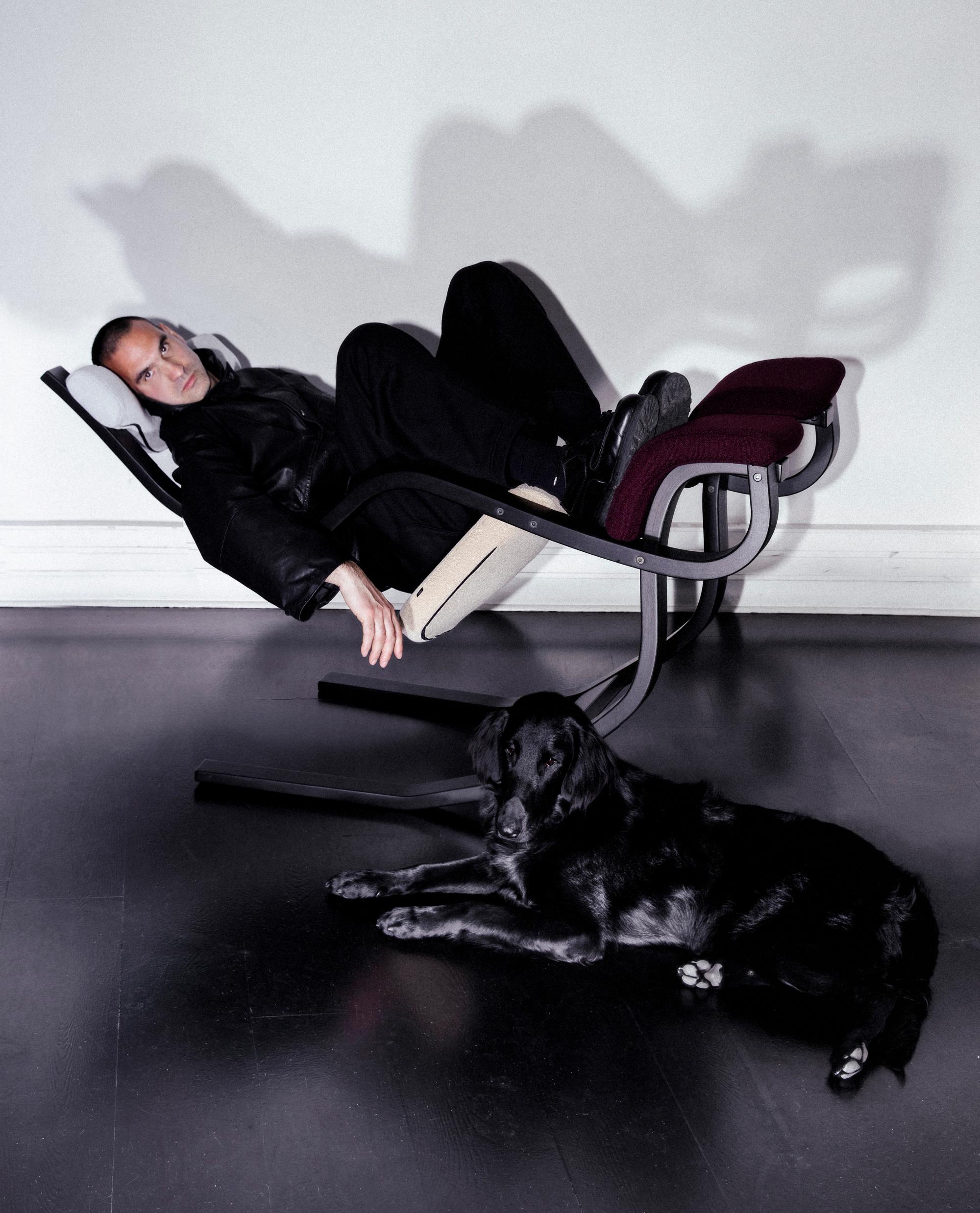
Growing up neurodivergent, it took me decades to understand that I wasn’t failing the system. I had internalized a logic never designed for how I function. Hours trapped in rigid utilitarian furniture, trying to force knowledge out of stillness. Nothing really worked. But maybe attention was never the issue. Maybe the classroom chair was.
Reflections on sitting: An essay by Thomas Subreville
I have always hated sitting.
Most chairs ask us to be still. They do not just support the body; they correct it. The classroom chair, the corporate throne, the museum bench, all carry the same silent command: sit properly, remain upright, stay in place. Instructional spaces are built on this premise: stillness is a prerequisite for learning and productivity. The chair often embodies this cultural ideal, somewhere between modernist fetish and institutional punishment. Design becomes an instrument of discipline, and stability becomes a condition for thinking. But for some of us, holding a single posture isn’t focus. It’s resistance.
"The chair often embodies this cultural ideal, somewhere between modernist fetish and institutional punishment"
I was raised on the promise that focus equals success, yet everything I have ever made emerged from drifting thoughts and non-linear thinking. I have always worked more efficiently walking to my studio than sitting at my desk. Sitting still makes it almost impossible for me to focus. My body keeps moving, constantly recalibrating, searching for alternatives most chairs were never designed to allow.
This is not incidental. It is structural.
For people with ADHD, balance is not a fixed state. It is an ongoing negotiation with instability, both practical and metaphorical. My mind zigzags, spirals, skips. It needs constant variation. Because of complex dopamine signaling differences, neurodivergent brains are often under-stimulated, especially when confronted with static environments.
Micro-movements like bouncing a leg, shifting weight, rocking, are not distractions for us. They regulate attention by increasing sensory feedback. This constant search for a better posture echoes Peter Opsvik’s idea that “the best sitting position is always the next one.” But this goes beyond ergonomics. It is a cognitive necessity. For people with ADHD, stimulation always lives in what comes next. The next idea, the next image, the next song is always the best one.
"Every slight change in posture rewires the emotional, visual, and speculative conditions through which we experience our environment"
What interested me in this project was that it treated movement not as failure, but as infrastructure for freedom. This chair does not fix the body in space but enables a continuous sequence of shifts. Every slight change in posture rewires the emotional, visual, and speculative conditions through which we experience our environment. We do not think the same reclining as we do leaning forward. We do not hear the same sounds, use the same language, or imagine the same things.
When I was first invited to rework the Gravity chair in 2022, I didn’t understand it immediately. It clicked later. My attraction to Opsvik’s work was never only about form or structural design. It was about no longer being forced into position. In a way, I recognized a system I had already been working within all along. One that aligns with the mind instead of forcing the mind to align with it. Not a chair that corrects ADHD, but one that leaves space for it.
Thomas Subreville.
"My attraction to Opsvik’s work was never only about form or structural design. It was about no longer being forced into position."
Mind Gravity 2.0
Paris-based creative practice Ill-Studio has reworked Peter Opsvik's iconic Gravity™ and presented it in a new context. Through the visual language of new materials, colors, and textures, Ill-Studio’s take on Gravity™ extends beyond the realm of sitting, blurring the lines between emotional engineering and ergonomic fantasy.