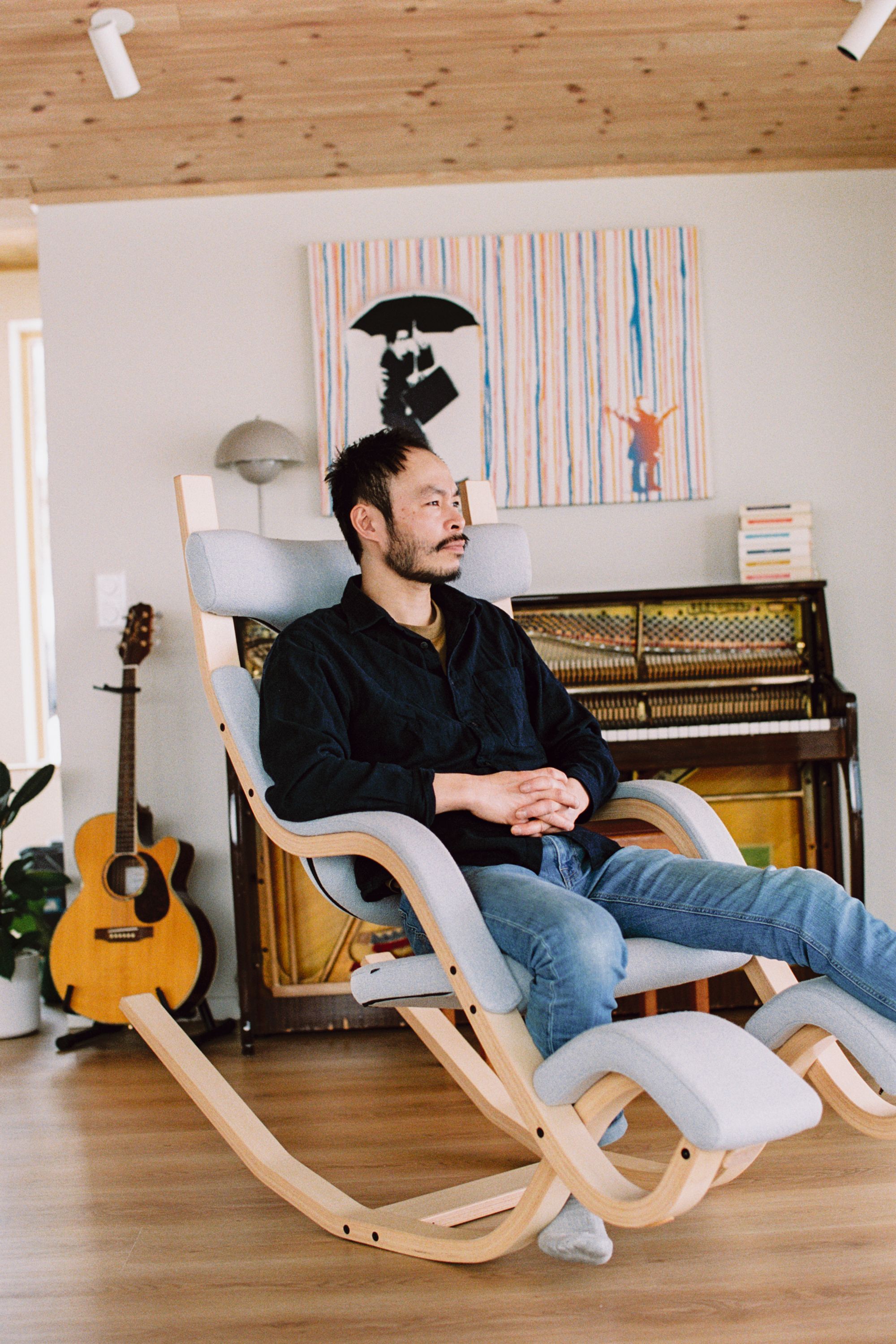
We visit Thien at the family farm he and his wife have taken over, where their newly built house sits higher up on the land, looking out over the original farmhouse below. From here, the view opens up - across the Tyrifjorden lake and over the surrounding wheat fields. As you step inside, a fresh smell of wood lingers in the air, coming from the workshop next to the entrance.
From Opsvik’s Workshop to Home
On a small farm outside Oslo, Thien lives with the objects he has spent nearly a decade working with. What began as a job has gradually become part of how he lives. As a product designer at the Opsvik Studio, he worked closely with Peter Opsvik in his later years, and continues to carry his ideas forward, not only through his work, but as part of his everyday life at home.
Photos by Johanne Nyborg
Variable™ Plus has found its place around the dining table, but is also often used in their home office in the basement.
His path into furniture was largely a coincidence. After studying industrial design in Trondheim and spending a year in Glasgow, he began his career in the oil industry. Years later, he came across a job listing for a small family business looking for someone interested in furniture and woodworking. “It didn’t mention the Opsvik name, so I had no idea. I also didn’t know who he was at the time”. It was a very different type of work compared to his experience in the oil industry, but not entirely unfamiliar. On his mother’s side, his family had worked with furniture carpentry in Vietnam.
“It was Peter’s universe. The main idea was always his, but we worked through the solutions together.”
Working with Peter Opsvik meant stepping into established creative framework - one where the idea always came first. “It was his universe. The main idea was always his, but we worked through the solutions together.” The process was fluid, often shifting between ideas and projects. For Thien, it was a different way of working, less structured, but deeply creative. “At first, it was very unfamiliar. But it was also extremely freeing. I feel like this job was created just for me, almost so perfect it doesn’t feel like a job.” Together with his collegue Per Olav Haugen, they would often spend time refining small details. “Sometimes just millimetres,” Thien says. “But it makes a difference.” Peter was rarely satisfied with the first solution. There was always something to refine, something to improve. “It always had to feel right first, before we focused on refining the visuals. This way of working is also the reason why many of Peter’s products have a distinctive visual expression. He was not tempted by trends and had his own artistic integrity which I really admire,” Thien says.
Gravity™ quickly became a favorite in the home, as his two young girls often compete over whose turn it is. Luckily, there’s room for them both.
In the basement, he has built his own workshop, where he spends time on both personal projects and work-related tasks. Much of the house reflects this hands-on approach, with solutions shaped by use rather than predefined plans. The kitchen, for example, was built from scratch - designed and made by hand, piece by piece. “Maybe I’ve adapted to Peter’s way of thinking, because I think of functionality first always, like how I can make waste sorting solution as effective and easy to use as possible.”.
“At first, it was very unfamiliar. But it was also extremely freeing. I feel like this job was created just for me, almost so perfect it doesn’t feel like a job.”
Alongside the practical work, music has always been big part of his life. He plays the piano and sings, something he mentions casually, but which also might have played a role in how he ended up working for Opsvik. “It actually came up in the interview with Peter. Later I was told that it might have been part of the reason I got the job,” he says, laughing.
Music was a natural part of the environment around Peter Opsvik. A shared interest in jazz shaped everyday life in the studio, alongside the work itself. In the living room, a piano stands by the window, inherited from Peter Opsvik.
“It always had to feel right first, before we focused on refining the visuals. This way of working is also the reason why many of Peter’s products have a distinctive visual expression. He was not tempted by trends and had his own artistic integrity which I really admire."
Details from the Thien’s workshop, that he built himself in basement.
At home, several of Opsvik’s designs are part of the everyday. They are not tied to specific functions - not one for work, another for the table - but used across situations, depending on the moment. “A chair is just that - a chair. You use it when you need to sit. Whether you’re eating or working, the function is the same,” he says.
Working closely with Peter Opsvik also meant changing the way he thinks about the body and how it sits. In the chairs developed at the Opsvik workshop, movement is not an added feature, but the starting point - a response to the fact that adults tend to become still once sitting down, while children move more naturally. The chair, then, is not meant to hold the body in place, but to support its need for variation. “After sitting on chairs that allow movement, you notice it immediately when you sit on a regular chair. It just doesn’t feel right,” he says.